
OpenAI GPT-5.6 Luna & Terra Price Cuts on Amazon Bedrock (July 2026)
Quick summary: On July 30, 2026 AWS cut Bedrock on-demand prices 80% for GPT-5.6 Luna and 20% for Terra. Luna is now $0.22/$1.32 per 1M tokens. This post covers the routing math and what not to re-price overnight.
Key Takeaways
- On July 30, 2026 AWS cut Bedrock on-demand prices 80% for GPT-5.6 Luna and 20% for Terra
- Luna is now $0.22/$1.32 per 1M tokens
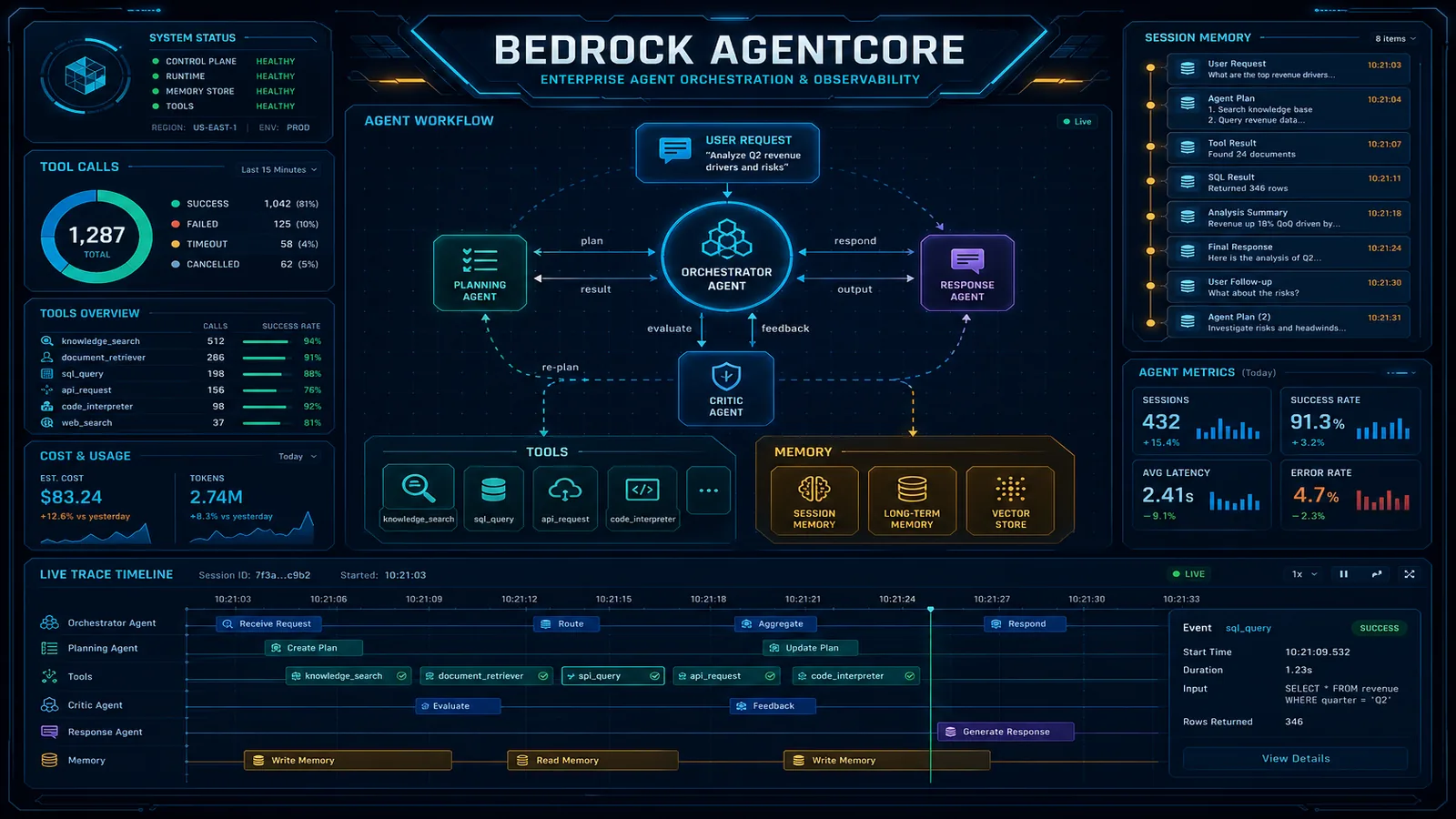
- AWS lifecycle notice (June 30, 2026): Amazon Bedrock Agents Classic is in maintenance for new customers after July 30, 2026
- Net-new agent builds should use Bedrock AgentCore
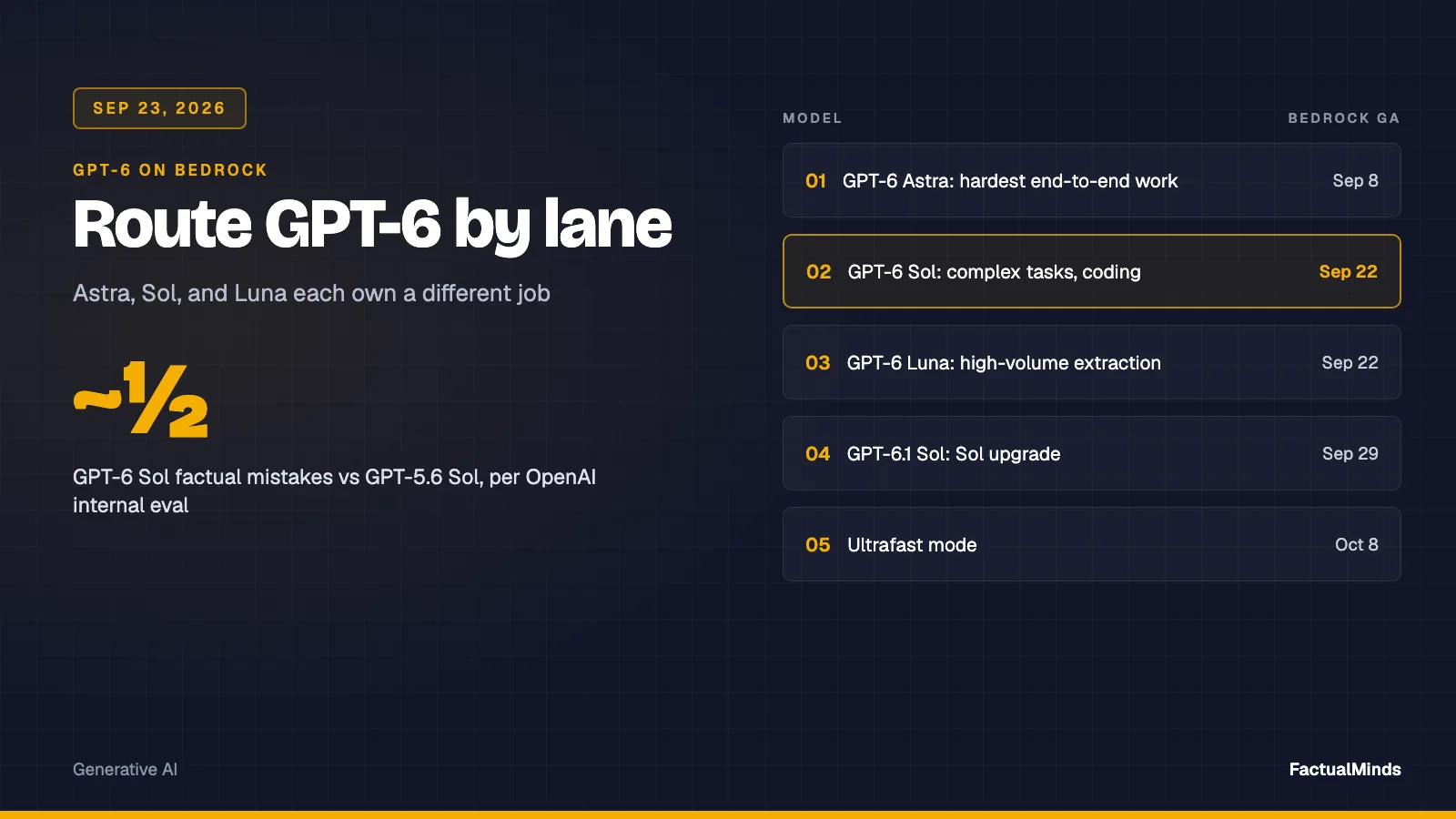
- Update (September 22, 2026): GPT-6 Sol and GPT-6 Luna are GA on Bedrock (up to 1M context, explicit prompt caching, lower API pricing than these GPT-5.6 pins)

Table of Contents
On July 30, 2026, AWS announced that on-demand inference prices on Amazon Bedrock for OpenAI GPT-5.6 Luna dropped 80% and GPT-5.6 Terra dropped 20%, in line with OpenAI’s first-party price cut. GPT-5.6 Sol is unchanged. The new rates apply automatically.
This is a routing and FinOps event. Do not just flip the default model ID. If you already run OpenAI on Bedrock (see our April 2026 OpenAI-on-Bedrock analysis), recalculate cost per completed task by lane, then promote only the lanes that still pass quality.
What changed on the Bedrock rate card
Published Amazon Bedrock on-demand rates after the cut (US East N. Virginia / Ohio and US West Oregon where listed):
| Model | Input / 1M tokens | Output / 1M tokens | Cache read / 1M | Cut vs prior |
|---|---|---|---|---|
| GPT-5.6 Luna | $0.22 | $1.32 | $0.022 | −80% |
| GPT-5.6 Terra | $2.20 | $13.20 | $0.22 | −20% |
| GPT-5.6 Sol | $5.50 | $33.00 | $0.55 | Unchanged |
Source: Amazon Bedrock pricing (OpenAI frontier table, after July 30, 2026). OpenAI’s global API list is slightly lower ($0.20/$1.20 Luna; $2/$12 Terra); Bedrock’s published in-region figures track OpenAI’s data-residency tier (~10% uplift). Treat the Bedrock page as the budget source of truth for AWS bills.
Implied prior Bedrock-equivalent rates (from the stated 80% / 20% cuts): Luna ≈ $1.10 / $6.60, Terra ≈ $2.75 / $16.50 per 1M input/output.
AWS positions the tiers the same way it did at GPT-5.6 GA:
- Luna: fast, high-volume: classification, summarization, routing, customer-service automation, routine tool workflows
- Terra: everyday production with stronger reasoning at GPT-5.5-class quality, lower cost
- Sol: flagship multi-step / agentic reasoning (price unchanged, so do not expect this cut to move Sol TCO)
On August 3, 2026, AWS expanded Sol, Terra, and Luna to 1 million token context windows on Bedrock. Prompt caching with explicit cache breakpoints applies to those long-context requests, so repeated prefix is billed at the cache-read discount rather than full input. That is a context and cache design change and not a second rate cut, so do not re-price the July 30 table because the window grew.
When 1M context matters: full-repo review, long legal packs, or multi-turn agent history that previously required chunking.
When it does not: classification/routing lanes already well under 200K. Sending a 1M window “because it is available” inflates uncached input until breakpoints are set.
First-party pricing math (not a client silhouette)
No anonymized engagement is cited for this specific July 30 cut. The numbers below are reproducible arithmetic on the published Bedrock rate card, shown as one illustrative monthly shape.
Illustrative Luna month: 50M input tokens + 5M output tokens (high-volume classification / routing mix).
| Period | Input | Output | Monthly total |
|---|---|---|---|
| Pre-cut (implied) | 50 × $1.10 = $55.00 | 5 × $6.60 = $33.00 | $88.00 |
| Post-cut (published) | 50 × $0.22 = $11.00 | 5 × $1.32 = $6.60 | $17.60 |
Direction: −$70.40 / month (−80%) for that token mix on Luna alone. Same volume on Terra post-cut: (50 × $2.20) + (5 × $13.20) = $176.00, still ~10× Luna for identical token counts, which is why model choice still dominates the bill.
Pair this with the broader playbook in Bedrock cost optimization: token budgets and model selection.
Opinionated routing after the cut
We recommend: default new high-QPS classification / extraction / thin-tool lanes to Luna on Bedrock Mantle after a frozen-prompt quality bakeoff. Keep everyday agentic production on Terra until Luna’s pass rate matches. Keep deep overnight / exploit-class / multi-hundred-step agents on Sol (or Claude Opus 5 where ZDR-default + Guardrails composition matter more; see Opus 5 on Bedrock).
Trade-off you accept: lower $ / MTok on Luna vs higher risk of silent quality regressions on nuanced prompts if you promote by price alone.
| Lane | Prefer after July 30 | Why |
|---|---|---|
| Classification, routing, summarization, high-QPS chat | Luna | −80% list price; built for volume |
| Everyday code gen, structured extraction, mid-tier agents | Terra (−20%) | Stronger reasoning without Sol rates |
| Long-horizon agents, cyber research, hardest coding | Sol (unchanged) or Claude Opus 5 | Capability / governance, not this price event |
| Cheap AWS-native alternatives | Nova / Haiku | Still worth A/B when OpenAI-specific behavior is not required; see the Nova guide |
For the enterprise Bedrock-vs-direct-API frame (IAM, PrivateLink, commitments), see AWS Bedrock vs OpenAI API.
What broke (pattern): cheaper tokens, same task cost
On-demand still wins for spiky traffic; if you were about to buy Provisioned Throughput for a Luna-class lane, re-run the break-even after this cut: on-demand vs Provisioned Throughput.
Invoke Luna / Terra on Mantle (Responses API)
Context: OpenAI Python SDK against Bedrock Mantle, region us-east-1, model IDs from the Luna / Terra model cards. Auth via Bedrock API key or SigV4 as documented for your path.
# openai>=1.x; OPENAI_BASE_URL=https://bedrock-mantle.us-east-1.api.aws/openai/v1
from openai import OpenAI

client = OpenAI()  # uses OPENAI_API_KEY + OPENAI_BASE_URL from env

response = client.responses.create(
    model='openai.gpt-5.6-luna',
    input='Classify this support ticket into billing, outage, or how-to. Reply with one label only.',
)

print(response)
Swap openai.gpt-5.6-terra for mid-tier lanes. Regions today: us-east-1, us-east-2, us-west-2 for Luna/Terra; Sol is us-east-1 / us-east-2 only. Geo/global inference IDs are not supported on these Mantle model cards at time of writing, so plan capacity inside those Regions.
What to do this week
- Pull last 30 days of Bedrock OpenAI token usage from Cost Explorer / CUR; split by model ID.
- Recompute monthly $ at the new Luna / Terra rows; leave Sol at $5.50 / $33.
- Pick one high-volume lane that is not Sol-dependent; freeze 50 to 100 production prompts; score Luna vs current model on pass rate, p95 latency, and $ / completed task.
- Enable prompt caching on sticky system + tool prefixes; confirm cache-read lines appear in CUR.
- Update budgets and anomaly detectors, since an 80% Luna drop can look like a “usage cliff” to naive alerts (FinOps Agent / Cost Anomaly context).
- If you are still on OpenAI direct for regulated data, revisit Bedrock for commitment consolidation and IAM: GenAI on AWS / Amazon Bedrock consulting.
What this post doesn’t cover
- A published FactualMinds latency/quality bakeoff of Luna vs Terra vs Claude Haiku/Sonnet on our prompt packs (no harness linked yet).
- OpenAI Fast-mode / Flex / Batch tier matrices beyond pointing at the OpenAI and Bedrock rate cards.
- Codex-on-Bedrock developer UX (covered in the OpenAI models + Codex post).
- EU / non-US regional availability for GPT-5.6 Sol/Terra/Luna beyond the three US Regions AWS listed.
Related reading
- Amazon Bedrock + OpenAI Models, Codex & Managed Agents
- AWS Bedrock vs OpenAI API: Enterprise Decision Guide
- AWS Bedrock Cost Optimization: Token Budgets and Model Selection
- Bedrock Provisioned Throughput vs On-Demand Break-Even
- Claude Opus 5 on AWS Bedrock (July 2026)
- Amazon Bedrock Nova Models Guide
- Generative AI on AWS · Amazon Bedrock services · AWS cost optimization
Frequently asked questions
How much did GPT-5.6 Luna and Terra drop on Amazon Bedrock?
What are the current Bedrock on-demand rates for GPT-5.6 Luna and Terra?
Should we move every OpenAI lane to Luna after the 80% cut?
When should we NOT switch models after this price cut?
Does GPT-5.6 usage on Bedrock count toward AWS commitments?
Which regions and API path do Luna and Terra use on Bedrock?

AWS Cloud Architect & AI Expert
AWS-certified cloud architect and AI expert with deep expertise in cloud migrations, cost optimization, and generative AI on AWS.


 Kevin W.