Real Estate PropTech on AWS (2026): MLS Ingest, Geo Search, and Image Pipeline Reference Architecture
Quick summary: For a regional PropTech platform (~420k listings, 38 MLS connectors), DynamoDB canonical store + OpenSearch geo cut p95 search latency from 340 ms to 48 ms, and image CDN cost dropped 62% with Intelligent-Tiering.
Key Takeaways
- Amazon OpenSearch Service supports k-NN vectors up to 16,000 dimensions per field (vector search docs), enough for listing embedding similarity at regional scale
- The petabyte-scale lessons from AWS HealthImaging do not apply here
- Benchmark pattern (not a cited client): Regional PropTech, ~420k active listings, 38 MLS connectors, search p95 340 ms, image storage $28k/mo on Standard
- Phase 1: DynamoDB canonical + OpenSearch (search p95 340 ms → 48 ms)
- Phase 2: S3 Intelligent-Tiering + CloudFront WebP (image CDN cost −62%)
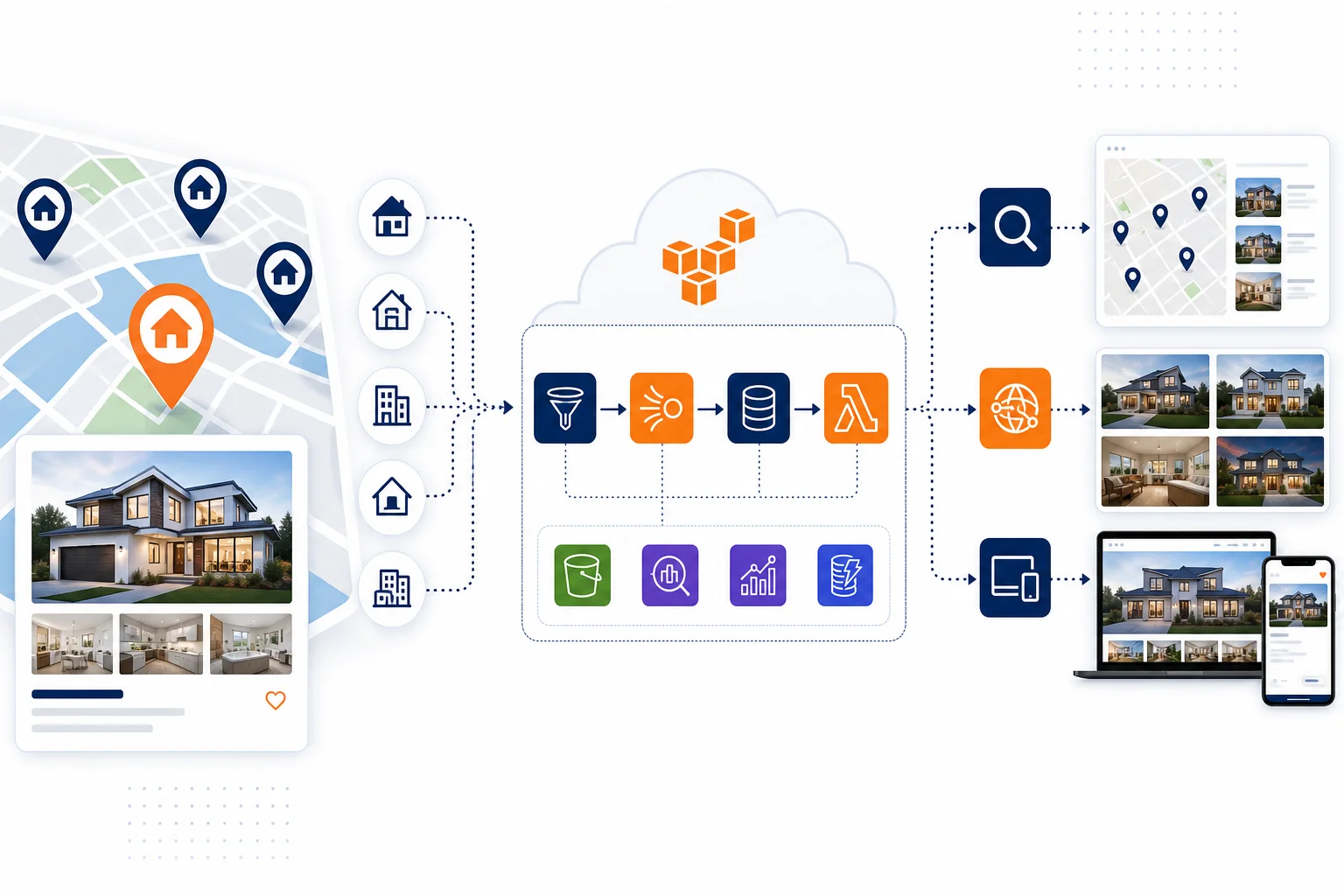
Table of Contents
Amazon OpenSearch Service supports k-NN vectors up to 16,000 dimensions per field (vector search docs), enough for listing embedding similarity at regional scale. PropTech wins on ingest discipline and geo index design. The petabyte-scale lessons from AWS HealthImaging do not apply here.
This post is the real estate / PropTech reference architecture, from MLS to mobile map. Retail analytics is covered in retail lakehouse analytics and fintech in fintech payments architecture. The industry hub FAQ covers the industry overview.
Artifacts: listing search tier matrix, MLS ingest cost worksheet, architecture diagram (draw.io).
Four lanes from MLS to mobile
| Lane | Question | Default AWS path |
|---|---|---|
| Ingest | How do feeds land safely? | Per-connector Lambda + Step Functions |
| Canonical | What is source of truth? | DynamoDB single-table |
| Search | How do users query map + text? | OpenSearch geo_point + optional k-NN |
| Media | How do photos load fast? | S3 → CloudFront WebP variants |
Opinionated take: DynamoDB canonical store before OpenSearch cluster. Teams that index MLS JSON directly into OpenSearch rebuild dedupe logic twice.
Reference architecture
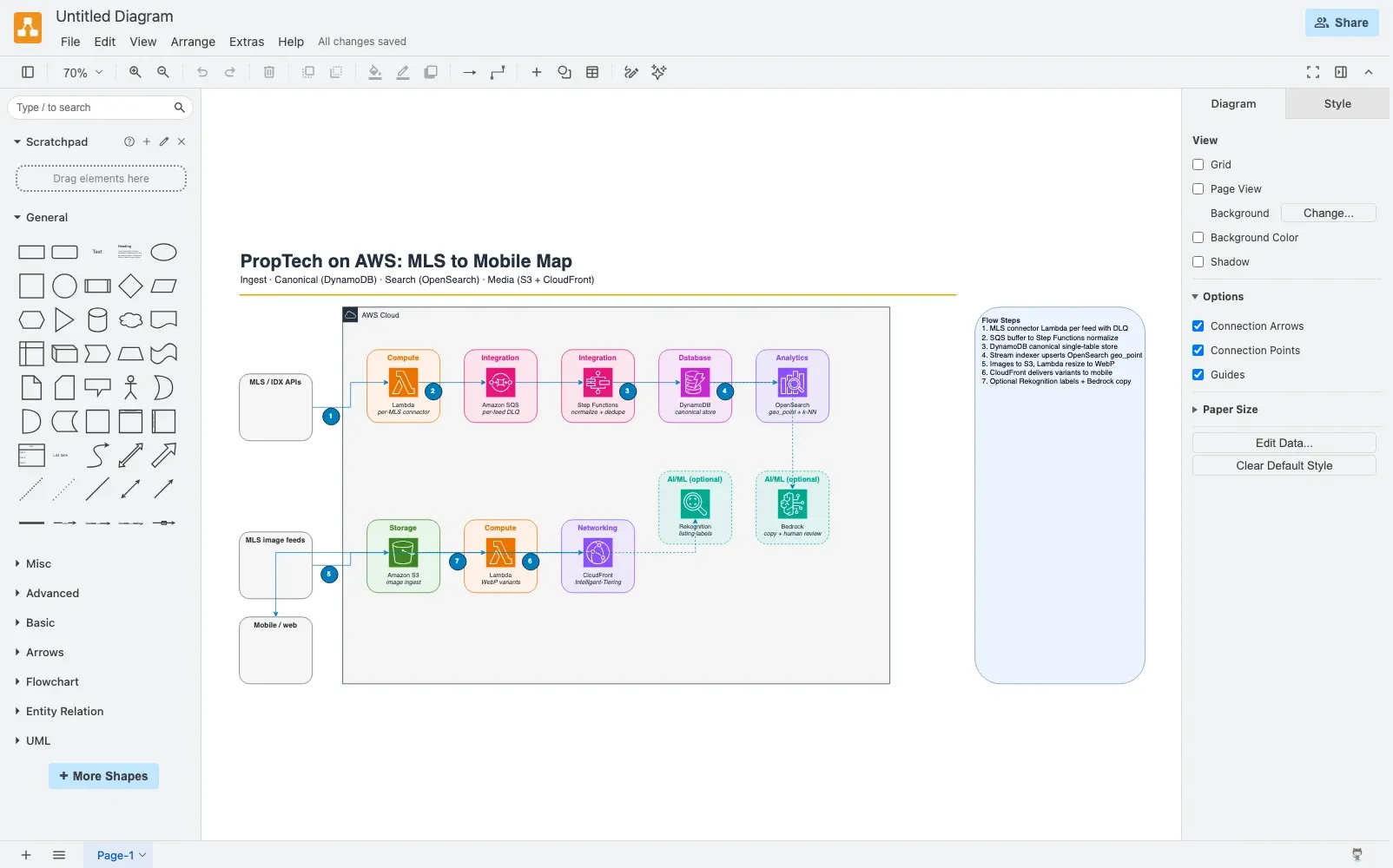
Figure: MLS ingest to DynamoDB canonical store, OpenSearch geo search, and S3/CloudFront image pipeline. Open draw.io source
MLS/IDX APIs ──► Lambda connector ──► SQS ──► Normalize ──► DynamoDB (canonical)
                                    │
                                    ├──► OpenSearch (geo_point, facets, k-NN)
                                    │
Images ──► S3 ingest ──► Lambda resize (WebP) ──► CloudFront ──► mobile/web
                                    │
Optional ──► Rekognition labels ──► listing enrichment
Optional ──► Bedrock ──► listing copy (human review gate)
Ingest: one connector, one failure domain
Per feed:
- Independent Lambda + DLQ, so one MLS outage does not poison others
- Normalize to unified schema; key
(marketId, listingId)+addressHashfor cross-MLS dedupe - Fill mls-ingest-cost-worksheet.csv after pilot week in Cost Explorer
Do not schedule full image re-sync 12×/day on large feeds. Use delta + ETag only.
Canonical: DynamoDB single-table
See DynamoDB single-table SaaS patterns:
- PK:
MARKET#<id>, SK:LISTING#<id> - GSI:
geoHash+statusfor bbox pre-filter before OpenSearch - Stream → OpenSearch indexer (idempotent upsert)
Search: OpenSearch geo plus optional k-NN
- Map
locationasgeo_pointforgeo_distanceand polygon filters - Enable k-NN when marketing needs “homes like this”, and watch memory: HNSW footprint scales with vector count (OpenSearch quantization blog)
- Amazon Location Place Index for autocomplete if address parsing is messy. Do not geocode twice in app and index
Images: cost control
- Generate
thumb,card,galleryWebP at ingest - Intelligent-Tiering after 90 days for stale listings
- CloudFront cache keys per variant. Never serve raw MLS TIFF to mobile
When NOT to escalate
| Situation | Stay lighter |
|---|---|
| MVP, one MLS, map-only | API Gateway + DynamoDB GSI |
| < 50k listings | Skip k-NN and second index |
| No OpenSearch ops owner | Managed cluster minimum + runbook first |
| CRE analytics / portfolio | Data lake post, not consumer search |
What to Do This Week
- Inventory MLS connectors and fill mls-ingest-cost-worksheet.csv.
- Run listing-search-tier-decision-matrix.md with product + finance.
- Implement DynamoDB canonical + one OpenSearch index for top market only.
- Switch image bucket to Intelligent-Tiering; measure CloudFront bytes-out for 7 days.
- Defer Bedrock listing copy until human review workflow exists.
What This Post Doesn’t Cover
- Title / escrow transaction workflows: downstream of search
- Commercial CRE lease abstraction: document AI, separate path
- Mortgage origination: fintech compliance cluster
- Specific MLS vendor contracts: legal/commercial, not architecture
We have not load-tested k-NN above 2M vectors on a single domain. Run the OpenSearch sizing calculator before national semantic search rollout.
Related: Real estate industry hub · Serverless services · Data analytics · Cost optimization
Frequently asked questions
When should we add OpenSearch vs DynamoDB GSI geo alone?
When should we NOT run 12x/day full MLS image re-sync?
What breaks when MLS duplicate keys collide?
How does this differ from retail omnichannel analytics?
Should we use Rekognition for property condition scoring?
What could go wrong during spring-buying-season traffic?

AWS Cloud Architect & AI Expert
AWS-certified cloud architect and AI expert with deep expertise in cloud migrations, cost optimization, and generative AI on AWS.

 Manoj V.