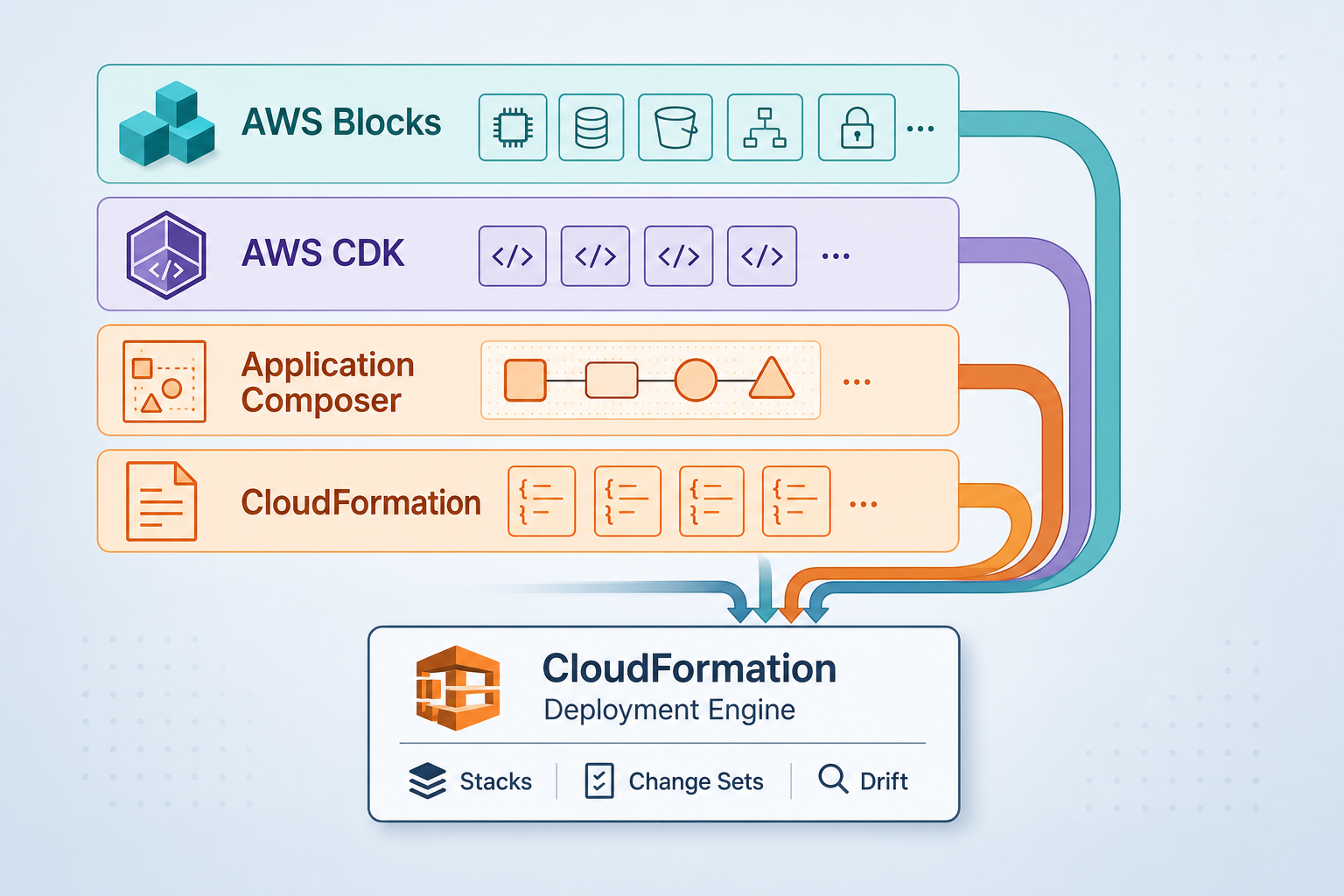
AWS DevOps & Platform Maturity Model (2026): A 4-Level Scorecard Anchored to Real Services
Quick summary: Generic DevOps maturity models score you on culture slides. This one maps L1 to L4 to AWS gates you can verify: IaC in Git, GitOps or gated CD, ADOT on EKS, FIS with stop conditions, and cost-aware CI. A composite 85-engineer SaaS moved from L2 to L3 in one quarter by fixing the CI/GitOps boundary alone, cutting deploy-related incidents from ~6/month to 2.
Key Takeaways
- This one maps L1 to L4 to AWS gates you can verify: IaC in Git, GitOps or gated CD, ADOT on EKS, FIS with stop conditions, and cost-aware CI
- A composite 85-engineer SaaS moved from L2 to L3 in one quarter by fixing the CI/GitOps boundary alone, cutting deploy-related incidents from ~6/month to 2
- On June 11, 2026, most AWS platform teams have a measurement problem more than a maturity problem
- This post is a four-level, AWS-anchored maturity model for platform and DevOps programs
- It is not a replacement for 10 AWS DevOps practices we use in production; that post covers what to do
Table of Contents
On June 11, 2026, most AWS platform teams have a measurement problem more than a maturity problem. Leadership asks for “DevOps maturity” and gets a CMMI worksheet or a DORA dashboard with deploy frequency and lead time, but no answer to the operational question: what do we build next quarter, and how do we know it worked? AWS has shipped concrete platform primitives since re:Invent 2024: declarative policies for durable EC2/VPC/EBS baselines, Resource Control Policies through February 2026 (including DynamoDB), ADOT as an EKS add-on, and FIS scenarios integrated with AWS Resilience Hub. Those land as feature announcements and not as levels on a scorecard.
This post is a four-level, AWS-anchored maturity model for platform and DevOps programs. It is not a replacement for 10 AWS DevOps practices we use in production; that post covers what to do. This one covers where you are and what to do next, with a downloadable scorecard and 90-day upgrade template.
The four levels and their AWS gates
| Level | Name | You know you’re here when… | AWS anchors |
|---|---|---|---|
| L1 | Ad-hoc | Console changes; no single deploy path; on-call learns about prod from users | Single account; CloudWatch optional |
| L2 | Repeatable | IaC in Git; CI builds/tests; deploy is manual, scripted, or pipeline-push | CodePipeline/GitHub Actions; Terraform/CDK; basic alarms |
| L3 | Managed | One writer to prod (GitOps or gated CD); multi-account LZ; app traces/metrics on tier-1 | EKS + Argo CD/Flux; Control Tower or LZA; ADOT; Config rules; Organizations SCPs |
| L4 | Optimizing | SLOs/error budgets; scheduled FIS with stop conditions; cost in CI; self-service golden paths | FIS + Resilience Hub; AMP/AMG or App Signals; tag policies + anomaly detection; IDP/templates |
Opinionated take: score per capability, not one number for the whole org. It is normal to be L3 on CI/CD and L1 on resilience.
Score yourself (use the artifact)
Download the maturity scorecard CSV. Eight capabilities:
- IaC foundation: versioned infra, drift awareness
- CI/CD delivery: who writes to prod?
- Multi-account: landing zone vs account sprawl
- Observability: infra metrics vs service SLOs
- Security shift-left: secrets, OIDC, scanning
- Resilience: hope vs FIS program (maturity matrix for FIS specifically)
- FinOps in platform: tags, chargeback, cost-aware CI
- Self-service: tickets vs golden paths
For each row, pick current and target level. If you cannot link evidence (pipeline URL, SCP ID, experiment template), pick the lower level.
The L2 to L3 jumps that move incidents
1. Delivery: one writer to production
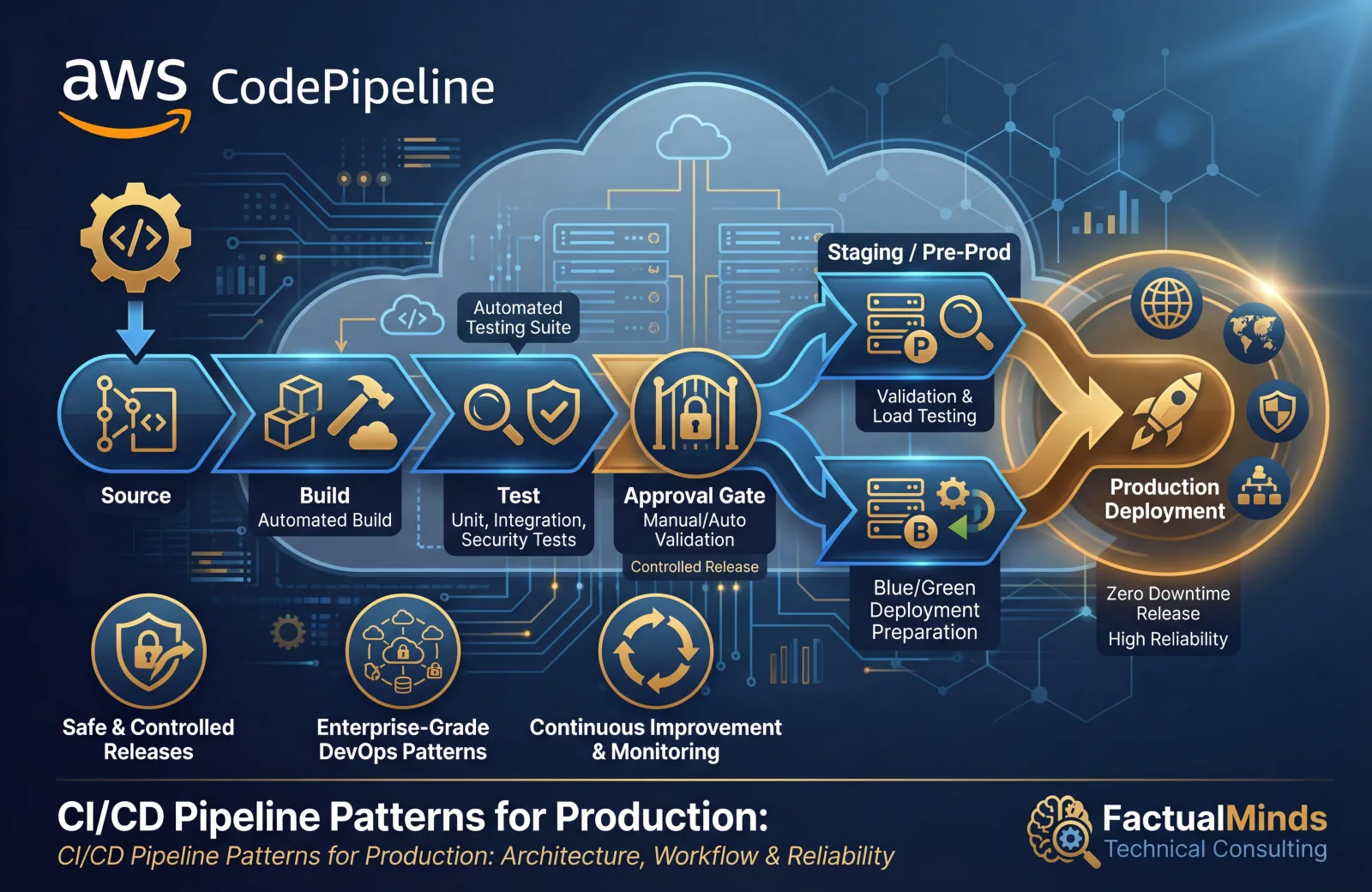
If CI and a human can both change prod, you are L2. L3 requires exactly one reconciler: GitOps on EKS or gated CodePipeline/CodeDeploy. See the GitOps post for the five traps; the maturity lens is simple: can a Git revert roll back prod? If not, stay L2 until fixed.
2. Multi-account: policy follows OU
L2 is “we have multiple accounts.” L3 is OU structure + baseline SCPs via Control Tower or equivalent, plus day-2 sharing patterns. Declarative policies (GA December 2024) belong in the platform baseline, not hand-maintained SCP denylists per API.
3. Observability: ADOT or equivalent on Kubernetes
L2 is CPU and 5xx alarms. L3 is traces + service metrics; on EKS the ADOT add-on is the supported path to CloudWatch, X-Ray, and AMP. Deep dive: observability beyond CloudWatch.
4. Resilience: one scheduled FIS experiment
L3 resilience means one FIS template with CloudWatch alarm stop conditions, run on a schedule in non-prod, documented steady-state hypothesis. L4 adds prod GameDays and pipeline gates; see FIS resilience program.
90-day upgrade (one capability only)
Use the level-up roadmap template. Rules:
- One capability level-up per quarter
- Weeks 1 to 2: baseline metrics only, no new tools
- Weeks 3 to 6: working change in non-prod
- Weeks 7 to 12: prod (tag-scoped) + re-score
Trying to move IaC, GitOps, FIS, and FinOps in one quarter is how programs stall at L2.
What to do this week
- Download the scorecard and fill current levels with evidence links.
- Pick one L2→L3 row, usually
cicd_deliveryormulti_account. - Run the delivery audit: does any human or CI job bypass the reconciler? If yes, that is this quarter’s project.
- Schedule a 60-minute re-score in 90 days with the same attendees and the same CSV.
What this post doesn’t cover
- Workload-level Well-Architected reviews: use WAFR for depth on a single system.
- DORA metrics benchmarking: we use levels here; you can map deploy frequency to levels separately.
- Full GitOps or FIS tutorials: see linked pillar posts.
- Team topology / platform org design: see CCoE operating model.
Related: DevOps pipeline setup · 10 AWS DevOps practices · GitOps on EKS · Cost-aware CI/CD
If you only do one thing: Score cicd_delivery honestly. If two systems write to production, fix that before buying any other platform tool.
Frequently asked questions
How is this different from the AWS Well-Architected Framework or a generic CMMI maturity model?
What level should a 50-person product engineering org target?
When is L4 "optimizing" maturity the wrong goal?
What is the fastest L2 → L3 upgrade if we can only fix one thing?
How does ADOT on EKS fit the maturity model?
What could go wrong if we score ourselves too optimistically?

Enterprise AI Transformation
Enterprise AI transformation and implementation leader focused on pilot-to-production playbooks, with a background in financial services. Writes the FactualMinds guides on serverless, CI/CD, and DevOps on AWS, the delivery plumbing production AI depends on.